
About Kinyan
The profession that creates all others now has a standard.
The premise
Ask any adult to name the people who shaped them, and a teacher appears on the list. Decades of research confirm what every parent senses: within the school building, nothing influences a child’s social, emotional, and intellectual development more than the quality of the teacher. A masterful teacher builds confidence, belonging, and a love of learning that lasts a lifetime — and measurably reduces the struggles that follow children who never find their footing in a classroom.
Medicine certifies its specialists. Music has its conservatories. Law has its bar. But teaching — the profession every other profession depends on — has had no equivalent in our community. No shared definition of mastery. No rigorous way to recognize it. No blueprint for developing it. Kinyan was founded to be that institution.
Our name is our thesis.
In the sixth chapter of Pirkei Avos, the Mishnah teaches that Torah is acquired through forty-eight kinyanim. A kinyan is not a purchase and not a lesson — it is the act by which something becomes permanently, irrevocably yours. Every parent has seen the difference between a child who was taught and a child who acquired. The first forgets by summer. The second is changed. Master teachers are the ones who create kinyan — and Kinyan exists to find them, honor them, and multiply them.
What we do
-
We define.
The Five Kinyan Standards articulate, in writing, what master teaching looks like in a yeshiva or day school classroom.
-
We assess.
The Kinyan Master Teacher Audit observes teachers in live classrooms and scores what it sees against an instrument built by credentialed experts in psychology and education.
-
We develop.
The Master Teacher Initiative cultivates excellent teachers toward mastery through observation-based feedback and coaching.
-
We celebrate.
Teachers who meet the standard are named master teachers — publicly, proudly, and on the record.
Two divisions, one conviction
Kinyan’s work with teachers — the Standards, the Audit, and the Master Teacher Initiative — is its primary mission today. Alongside it, Kinyan is developing Kinyan Academy, an online, skills-based Torah academy where students acquire the skills of independent Torah learning. Both divisions rest on the same conviction: learning is real only when it is acquired.
The people behind the Standard
The Kinyan Master Teacher Audit was created by Dr. Rebecca Eliason, Psy.D., M.S., Sarah Chana Radcliffe, M.Ed., C.Psych., and Rabbi Jonathan Rietti, M.Ed. — three careers spent inside classrooms, clinical practice, and teacher development. The instrument and the mission carry the endorsement of HaGaon HaRav Asher Weiss, shlita, and Dr. David Pelcovitz, Ph.D.
-

Dr. Rebecca Eliason, Psy.D., M.S.
Co-creator of the MTSA
-

Sarah Chana Radcliffe, M.Ed., C.Psych.
Co-creator of the MTSA
-

Rabbi Jonathan Rietti, M.Ed.
Co-creator of the MTSA
Endorsed by
-

HaGaon HaRav Asher Weiss, shlita
Endorses the MTSA
One of the generation’s foremost halachic authorities.
-

Dr. David Pelcovitz, Ph.D.
Endorses the MTSA
A leading authority on child psychology and education.
Kinyan is operated by Kinyan Academy Corp, a 501(c)(3) nonprofit organization.

In his own words
Dr. David Pelcovitz, Ph.D.
A leading authority on child psychology and education
Dr. David Pelcovitz holds the Gwendolyn and Joseph Straus Chair in Psychology and Education at Yeshiva University’s Azrieli Graduate School, and has written and lectured widely on parenting, resilience, and the inner lives of children.
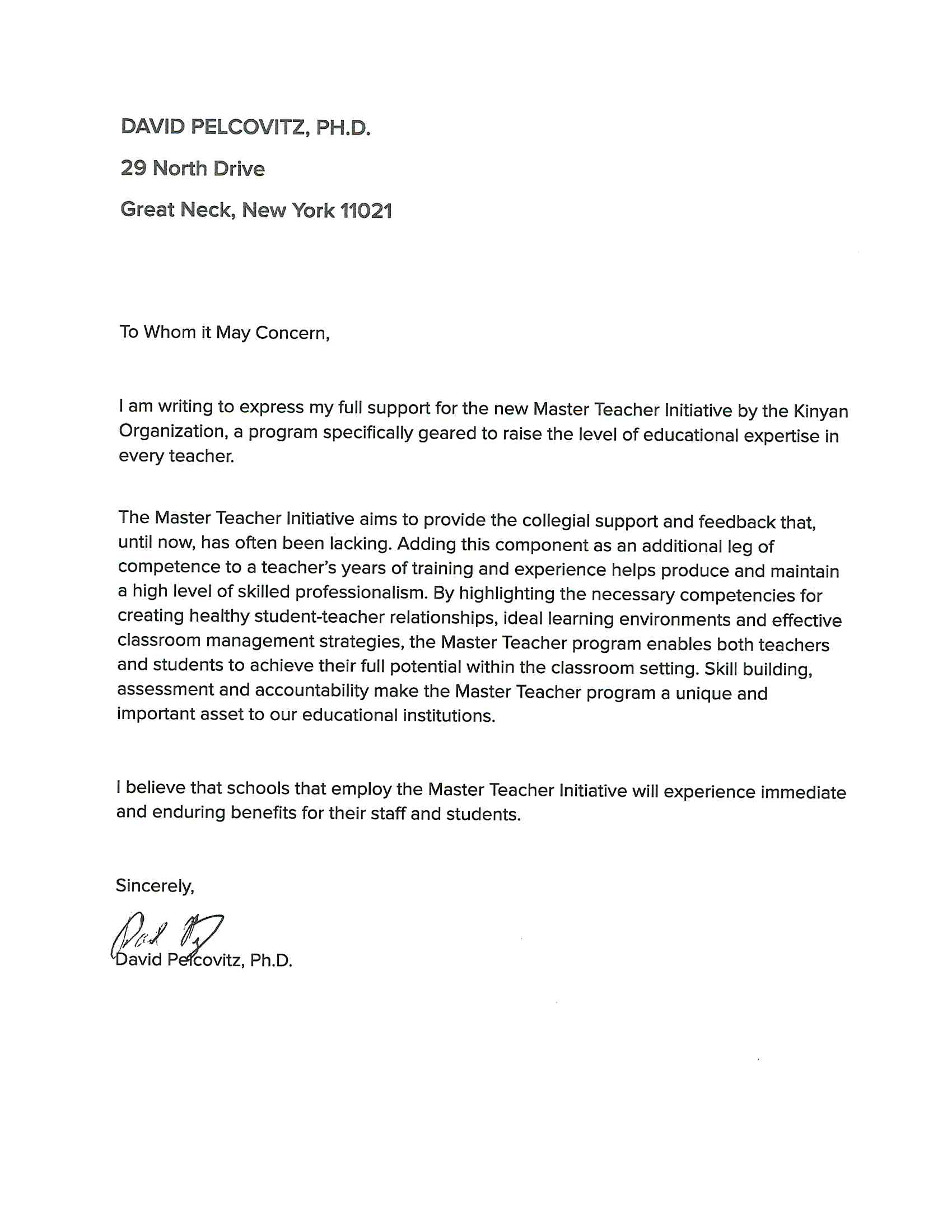
His endorsement of the Kinyan Master Teacher Audit is set out, in his own hand, in the letter at right. It speaks to what the standard is built to protect: the relationship between a teacher and a student, and the lasting difference a master teacher makes in a child’s life.
From our co-creator
Sarah Chana Radcliffe, M.Ed., C.Psych.
Co-creator of the MTSA
Open Heart, Open Mind
How Emotions Affect Learning
A classroom, a teacher, material to be learned — one may assume that this is all it takes in order to teach effectively. However, the main player — the learner — is the biggest factor in the teacher-student dynamic. He is the essential missing element from this list of ingredients. Yes, one can give material over but one cannot guarantee that it is being received and if it isn’t being received then “teaching” isn’t actually occurring. Teaching happens when the student learns.
The question then becomes, how can we increase the likelihood that the student will learn? There are many factors that affect learning, including the nature of the student’s brain (qualities such as intelligence, learning differences, processing differences and so on), the physical features of the classroom (comfort level, distraction level and so on), the manner in which material is being presented (modalities, style of teaching, and so on) and more. However, one of the most important factors determining the learning potential of a student is his emotional status. How emotionally receptive is the student to the teacher?
One might wonder what emotional receptivity is and why it matters so much. We go to school, the teacher teaches, and whether we’re interested and enthused or bored and turned off, we absorb enough to pass the year. Most of us learn enough to literally make the grade and go on to do the same the next year. What does emotion have to do with anything?
In fact, emotion affects how much we really learn — how much we absorb, how easily we absorb it and how accessible it remains throughout our lifetime. Motivation — a flavor of emotion characterized by energetic, intentional and positive focus — sends bits of information deep into the neural structure, organizes it and prepares it for ready access. When we want to learn a language for travel or work purposes, the brain opens up like the mouth of a hungry chick. The information drops in — no constriction or barriers slowing it down or muddling it up. We swallow it whole!
When we can harness a student’s motivation, we have a powerful learning tool. Motivation comes from two possible sources — intrinsic and extrinsic. If a grade 5 student realizes that acquiring the basic tools for learning Talmud will enhance his lifetime learning abilities and affect his spiritual development, his success in yeshiva, his future options and possibly his career, then he’ll surely listen attentively, ask questions, practice intently, do his homework and apply himself with every fiber of his being. Of course, this sort of intrinsic motivation for learning occurs in grade 5 students almost never.
Teachers know this and therefore aim to create motivation from extrinsic factors. Marks, grades, prizes, incentives — these can wake a student up and cause him to learn “lo lishma” — not for the sake of Torah exactly, but rather for the perks. This, as we know, is fine as it will one day surely lead to the pleasure that results in learning for its own sake. But while the types of “perks” mentioned here work well for some students, they certainly don’t work for all. In fact, when a student doesn’t like the teacher or rebbe, perks may be rendered irrelevant. And when the student does like the instructor, perks may be unnecessary altogether. Equally important, the student’s own feeling of being accepted or rejected by his teacher strongly affects his motivation for learning. This is because the emotion generated by a positive student-teacher relationship is more universally motivating than any other factor. A student who trusts, respects, admires and likes his teacher and who feels that his teacher trusts, respects and likes him will be most receptive to whatever this teacher is offering. A strong teacher-student bond creates the ideal conditions for optimal learning.
But here’s the rub: creating this bond requires skill. Certainly some educators are naturally more “charismatic” than others, drawing their students to them “like flies.” However, every educator needs to develop this ability to attract their students in order to ensure that true education takes place. Fortunately, the skills involved in building and maintaining strong, positive teacher-student bonds are easily acquired. Indeed, the purpose of the Kinyan Academy Master Teacher’s Certificate Program is to ensure that every educator has access to these skills so that every student can achieve his academic potential.
— Sarah Chana Radcliffe, M.Ed., C.Psych., co-creator of the Kinyan Master Teacher Audit. See how this shapes our approach →
The standard is written. Now bring it to your school.
Bring Kinyan to Your School →